How to Calculate Zakat: The Complete Guide
Nisab, the hawl year, and the 2.5% rate — everything you need to calculate your zakat correctly.
Published August 20, 2026 · Reviewed by the Ihsabha Editorial Team
Zakat is one of the five pillars of Islam, and for most Muslims the first practical question is simple: how much zakat do I actually owe? This guide walks through the full calculation for cash, savings, and general wealth (zakat al-mal) — the category that applies to the vast majority of people — covering who must pay, the two ways to measure the nisab threshold, how the hawl year works, and how to apply the 2.5% rate correctly, with worked examples. Whether you're calculating zakat for the first time or reviewing your annual habit, the goal here is a method you can trust and repeat every year with confidence.
What Is Zakat and Why It's Calculated This Way
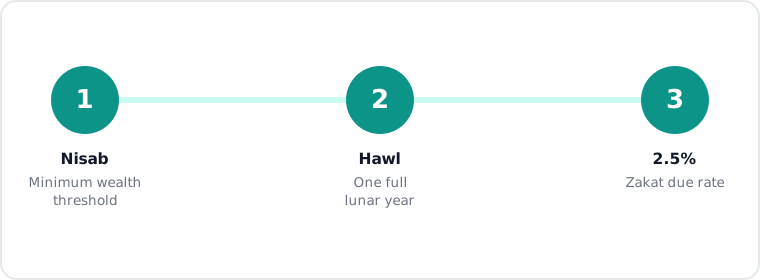
Zakat is an obligatory act of worship, not a voluntary donation — it's a fixed share of wealth that Muslims who meet certain conditions are required to give each year, distributed to specific categories of recipients defined in the Quran. Unlike sadaqah (voluntary charity), zakat has precise rules: a minimum wealth threshold (nisab), a minimum holding period (hawl), and a fixed rate (2.5% for cash-type wealth), rather than being left to personal discretion about amount or timing. You may also find it useful to check Zakat on Cryptocurrency and Bitcoin: How Much You Owe, which covers a related angle. You can use the free Zakat Calculator to get the result instantly, with no manual math.
Who Must Pay Zakat?
- Muslim — zakat is a worship obligation specific to Muslims.
- Adult and of sound mind — the majority view exempts minors and those who are not mentally competent from the personal obligation, though some scholars hold that a guardian should still pay zakat from a minor's wealth on their behalf.
- Free of debt that would drop them below nisab — see the debt-deduction section below.
- Wealth reaches nisab and stays there for a full hawl — covered in detail in the steps that follow.
What's Not Included in Zakatable Wealth
Just as important as knowing what counts is knowing what doesn't. Personal-use items are excluded entirely from zakat calculations, regardless of their value: the home you live in, the car you drive, furniture, everyday clothing, and personal electronics. These items add to your overall net worth but never enter the zakat calculation, because zakat is assessed on wealth that is growing, productive, or held for trade — not on assets used for daily living. A house worth $500,000 that you live in contributes nothing to your zakat base; a second property held purely as a rental investment is treated differently and may fall under zakat on rental income, which is calculated on the rental proceeds rather than the property's value itself.
Retirement accounts occupy a genuinely gray area that depends heavily on accessibility — funds you can freely withdraw are generally treated like any other savings, while funds locked until a future retirement date are subject to differing scholarly opinions about whether zakat is due annually or only once, when the funds finally become accessible. If a meaningful portion of your wealth sits in a pension or retirement account, it's worth reading a dedicated guide on that specific situation rather than applying the general formula in this one.
Step 1: Add Up Your Zakatable Wealth
Start with everything that counts toward your zakat base:
- Cash on hand and in bank accounts — checking, savings, and any cash you're holding, in any currency.
- Savings and fixed deposits — including term deposits, provided they're accessible or will mature within a reasonable timeframe.
- Gold and silver not used as everyday jewelry (and, per many scholars, jewelry held as investment or beyond a customary amount).
- Money owed to you that you reasonably expect to be repaid, whether a personal loan you extended or unpaid work you're owed for.
- The market value of business inventory, if you own a business — goods held for resale count at their current market value, not their purchase cost.
- Investment holdings such as stocks, crypto, or trade-focused property, valued at current market price (each has its own specific calculation nuances — see our dedicated guides linked below).
Then subtract short-term debts you owe that are due within the year — what remains is your net zakatable wealth, the figure you'll compare against nisab.
Intention, and Paying Zakat Early or Late
Like other acts of worship in Islam, zakat requires a clear intention (niyyah) at the time of payment — simply giving money away doesn't count as zakat unless the giver consciously intends it as such. This matters practically if you make several charitable payments across the year and want at least one to count toward your zakat obligation; it's worth explicitly noting, even just mentally, that a specific payment is intended as zakat.
Paying zakat slightly early — before your hawl date, once you're confident you'll remain above nisab — is generally permitted and can be useful for spreading payments out or responding to an urgent need among recipients. Delaying payment past your hawl date without a valid excuse is discouraged and, in the majority view, doesn't remove the obligation; the zakat remains due and should be paid as soon as possible, calculated on the wealth you held at the original due date, not a reduced or increased figure based on the delay. For a deeper look, our guide on Zakat on Salary and Employment Income: How Much You Owe covers this in more detail.
Step 2: Check It Against the Nisab
The nisab is the minimum threshold your net wealth must reach before zakat becomes obligatory at all. There are two accepted ways to calculate it, based on two different precious metals:
- Silver standard: the cash equivalent of 595 grams of silver.
- Gold standard: the cash equivalent of 85 grams of gold.
Because silver's market price is generally much lower than gold's relative to these weights, the silver-based nisab is almost always the lower of the two figures — which means zakat becomes obligatory sooner, at a lower level of wealth, and consequently reaches more recipients. For this reason, the majority of contemporary scholars and zakat authorities recommend using the silver standard for cash, savings, and mixed general wealth, since it's considered the more cautious position for the person paying and the more generous one for those in need. The gold standard is more commonly applied specifically to wealth held mainly in gold itself. If your net wealth is below the applicable nisab, no zakat is due that year — but you'll want to recheck once your wealth grows or at your next annual review date. Rather than working this out by hand every time, the free Zakat Calculator can handle the whole calculation for you.
Step 3: Confirm the Hawl (One Full Lunar Year)
Zakat only becomes due once your wealth has remained at or above the nisab continuously for a full Hijri (lunar) year — this holding period is called the hawl. Many people simplify tracking this by choosing one fixed date annually, commonly the start of Ramadan, and calculating zakat on their total holdings as of that date each year, rather than tracking the exact date wealth first crossed nisab for every individual asset.
If your wealth drops below nisab at any point before the hawl completes, most scholars hold that the clock resets — a new hawl begins only once wealth returns to or above the threshold again. Day-to-day fluctuations that don't meaningfully cross the threshold generally aren't treated as breaking the hawl in practice, but a genuine, sustained drop below nisab does reset it under the majority view.
Step 4: Apply the 2.5% Rate
Once nisab and hawl are both satisfied, the zakat due is a flat 2.5% of your total net zakatable wealth — no sliding scale, no brackets, the same percentage whether your wealth is just above nisab or many times larger. You can find a fuller explanation of this specific point in Zakat on Retirement Accounts and Pension Funds.
Handling Multiple Currencies and Fluctuating Values
Many people hold wealth across more than one currency, or in assets whose value shifts daily, like stocks or crypto. The practical approach is to convert everything to a single reference currency — typically your home currency — at the exchange rate on your hawl date, rather than trying to track each currency's zakat separately. For volatile assets, pick one consistent valuation moment (such as the closing price on your hawl date) and apply it across your entire portfolio, rather than averaging prices over a period, which tends to create more disputes about accuracy than it resolves. Consistency from year to year matters more than chasing a theoretically perfect valuation method — a simple, repeatable approach you can defend and explain is more valuable than a complex one you can't consistently reproduce.
Worked Examples
Example 1 — Simple cash savings. Net zakatable wealth of $10,000, held above nisab for over a full year: $10,000 × 2.5% = $250 due as zakat.
Example 2 — With debts on both sides. Someone has $15,000 in savings, is owed $2,000 by a friend who they're confident will repay it, and owes $3,000 on a credit card due this month. Net zakatable wealth: $15,000 + $2,000 − $3,000 = $14,000. At 2.5%: $350 due.
Example 3 — Mixed assets. A person holds $8,000 cash, gold jewelry valued at $3,000 held as investment beyond customary personal use, and $4,000 in stocks. Total: $15,000. At 2.5%: $375 due, assuming all three assets have independently met their own nisab and hawl conditions — in practice, most people combine everything into one annual snapshot on their chosen hawl date for simplicity.
Skip the manual math entirely. Ihsabha's free Zakat Calculator handles nisab comparison and the 2.5% calculation instantly. If your wealth is mostly cash and bank savings, the dedicated Cash & Savings Zakat Calculator is even faster, and if it includes gold or silver, our Gold & Silver Zakat Calculator applies the correct metal-based nisab automatically. For an instant, practical check, the free Zakat Calculator is ready to go.
How This Differs From Other Types of Zakat
Zakat al-mal (general wealth zakat, covered in this guide) is only one of several distinct zakat categories, each with its own rules: zakat on crops and fruits (Ushr) is due at harvest with no hawl requirement and a rate of 5–10% depending on irrigation; zakat on livestock uses entirely separate nisab tables by animal type and headcount; and Zakat al-Fitr is a fixed per-person amount due before Eid prayer, unrelated to wealth or nisab at all. If your situation involves any of these, it's worth reading the dedicated guide rather than applying the general 2.5% cash formula, since the underlying logic is genuinely different. If you want to go further, Zakat on Stocks and Investments: How to Calculate What You Owe explains this point in more depth.
Who Receives Zakat
Zakat isn't given freely to anyone — the Quran names eight specific categories of eligible recipients (asnaf), including the poor, the needy, those in debt, and several other defined groups. Giving zakat to a category outside this list, even a worthy cause, doesn't fulfill the obligation in the majority view. Our full guide to zakat recipients covers all eight categories and common questions about giving to relatives or sending zakat abroad.
Common Mistakes When Calculating Zakat
- Using net worth instead of zakatable wealth. Personal-use items — your home, car, furniture, everyday clothing — are excluded entirely, even though they add to your overall net worth.
- Forgetting money owed to you. Loans you've extended to others that you expect to recover should be added to your zakatable total, not ignored just because the cash isn't currently in hand.
- Deducting long-term debt in full. Only the portion of a long-term debt (like a mortgage) due within the coming year is generally deducted, not the full remaining balance.
- Picking a hawl date and never revisiting it. If your wealth dipped below nisab at any point and only recovered later, your hawl should generally restart from the recovery date, not continue from your original fixed date.
- Mixing up the gold and silver nisab and ending up with an inconsistent threshold from year to year — pick one standard (silver is the more common default) and apply it consistently.
- Averaging asset values over time instead of using a single consistent valuation date, which makes the calculation harder to reproduce and defend from one year to the next.
- Skipping the intention (niyyah) when making a payment, or assuming any charitable donation automatically counts as that year's zakat without consciously designating it as such.
Frequently Asked Questions
How much is zakat on savings?
2.5% of your total savings, once nisab and hawl conditions are met.
What is the nisab for zakat?
Commonly the cash equivalent of 595 grams of silver or 85 grams of gold — many scholars recommend the (usually lower) silver value when combining it with cash savings.
Do I pay zakat on money others owe me?
Generally yes, if you reasonably expect repayment — though views differ on debts that are unlikely to be recovered.
Should I use the gold or silver nisab standard?
Most scholars recommend the silver standard for cash and mixed wealth because it is lower, meaning zakat becomes obligatory sooner and benefits more recipients — considered the more cautious and generous position. The gold standard is sometimes used for wealth held mainly in gold itself.
What happens if my wealth drops below nisab during the year?
If wealth drops below nisab at any point before hawl completes, most scholars hold that the hawl clock resets. Once wealth rises back to or above nisab, a new hawl period begins from that point.
Do I subtract debts I owe before calculating zakat?
Yes, short-term debts due within the year are generally subtracted from your total zakatable wealth before comparing it to nisab and applying the 2.5% rate. Long-term debts, such as a mortgage, are typically not fully deducted — only the portion due within the coming year.
How is zakat calculated on a small business?
Business inventory held for resale is valued at its current market price, added to cash and receivables owed to the business, minus short-term business liabilities, with the 2.5% rate applied to the net figure once it clears nisab and hawl — fixed business assets like equipment or the shop premises itself are generally excluded, similar to personal-use assets.
Building a Reliable Annual Habit
The single biggest factor in getting zakat calculations right isn't a complex formula — it's consistency. Pick one hawl date, ideally something memorable like the start of Ramadan or your birthday, and use it every year without exception. Keep a simple running note of your zakatable assets as they change through the year, rather than trying to reconstruct twelve months of financial activity in one sitting. Over a few years, this turns an annual scramble into a five-minute check-in, and it also makes it far easier to spot genuine changes in your financial picture, like a debt that's grown, an asset that's dropped below nisab, or new savings that have crossed the threshold for the first time.
A Note on Accuracy
This guide covers the standard, widely-followed method for general wealth. Specific assets — business inventory, mixed-currency holdings, or complex debts — can involve additional considerations. For anything beyond routine personal savings, confirm your specific case with a qualified local scholar.
Keep Exploring
Put this into practice with Ihsabha's Trade Assets Zakat Calculator and Stocks Zakat Calculator. For related reading on Ihsabha's blog, see Zakat on Cash and Bank Savings, How to Track Your Zakat Payments Every Year, and Who Is Eligible to Receive Zakat?.