The Complete Hajj Guide
From preparation through the days of Hajj, and what to do if a rite can't be completed.
Published August 21, 2026 · Reviewed by the Ihsabha Editorial Team
Hajj is the fifth pillar of Islam and, for most Muslims, the journey of a lifetime — planned for over months if not years, and performed only once as an obligation. This guide walks through who must go, the practical decisions to make before you travel, a full day-by-day breakdown of the rites from the 8th to the 13th of Dhul Hijjah, and what happens if illness or circumstance makes it impossible to complete a specific rite.
Who Is Required to Perform Hajj?
Hajj becomes obligatory, once in a lifetime, on any Muslim who meets four conditions scholars group under the term istita'ah (capability):
- Being Muslim, adult, and of sound mind — Hajj is not obligatory on children or those who are not mentally competent, though a Hajj performed as a minor is still valid and rewarded, it does not fulfill the later adult obligation.
- Physical ability — a reasonable capacity to handle the walking, standing, and physical demands of the rites, taking age and health into account.
- Financial ability — enough wealth to cover the cost of the journey and to support any dependents left behind, without going into debt or depriving them of their needs.
- A safe, viable route — historically interpreted as the road being reasonably safe to travel; today this extends to visa access and logistical feasibility.
If any of these conditions genuinely isn't met, Hajj is not obligatory that year, though many Muslims still plan and save toward it as a long-term goal. This is also why zakat and Hajj savings are often planned together — Ihsabha's Zakat Calculator can help you keep your annual zakat obligation separate and accurate while you save toward the journey. You may also find it useful to check Zakat on Cryptocurrency and Bitcoin: How Much You Owe, which covers a related angle. To save time, enter your values into the Hajj Days & Duration Calculator and get an instant result.
Hajj vs. Umrah: What's the Difference?
The two are often confused by newcomers. Umrah is a shorter pilgrimage — mainly Tawaf (circling the Kaaba) and Sa'i (walking between Safa and Marwah) — that can be performed at almost any time of year and is strongly recommended but not obligatory. Hajj is obligatory once in a lifetime for those who are able, can only be performed during a fixed window of days in Dhul Hijjah, and includes rites Umrah does not have, most importantly the standing (wuquf) at Arafah, which scholars describe as the very core of Hajj — a hadith states plainly that "Hajj is Arafah." If you're planning Umrah specifically, or a Hajj that includes an Umrah component, our Umrah guide for first-timers covers that shorter pilgrimage in detail.
The Three Types of Hajj
Before you travel, you'll need to decide which of three recognized forms of Hajj you'll perform — this affects your intention (niyyah) at ihram and the order of your rites:
- Hajj al-Tamattu' (the most common choice for pilgrims arriving from outside Saudi Arabia): you perform Umrah first during the Hajj season, exit ihram, then re-enter ihram for Hajj itself a few days later. This path requires an animal sacrifice (hady) as part of the ritual.
- Hajj al-Ifrad: you perform Hajj only, with a single continuous ihram, and no separate Umrah. No sacrifice is obligatory for this type specifically (though the general Eid sacrifice may still apply separately).
- Hajj al-Qiran: you combine the intentions for both Umrah and Hajj into one continuous ihram from the start, without exiting ihram in between. Like Tamattu', this requires a sacrifice.
Most pilgrims traveling with organized groups are guided toward Tamattu', since it's considered easier logistically for those arriving from abroad, but the choice is a matter of permissible preference — discuss it with your group's religious guide if you're unsure which fits your circumstances. It's also worth reading Zakat on Salary and Employment Income: How Much You Owe if this situation applies to you.
Before You Travel: Preparation
- Choose your Hajj type in advance, since it determines the intention you state at your miqat (the boundary point where ihram begins).
- Sort out logistics early: visa, accommodation in Makkah and Mina, and whether you're traveling independently or with an organized group, which handles much of the on-the-ground coordination.
- Mahram requirements for women — the majority view is that a woman should be accompanied by a mahram (husband or a close male relative she cannot marry); some contemporary fatwa councils permit travel in a trusted, organized women's group where a mahram isn't available, particularly for older women.
- Physical readiness matters — Hajj involves long walking distances, standing for hours in heat, and dense crowds, especially at Arafah and during the stoning of the Jamarat. Building up stamina and comfortable, broken-in footwear in the months before travel makes a real difference.
- Learn the rites in order before you go, ideally with a step-by-step reference you can also use on the ground, so each day feels familiar rather than overwhelming.
- Settle your finances before departure — pay off debts where possible, and make sure any zakat due that year is calculated and set aside, since Hajj does not exempt you from other outstanding religious financial obligations.
Entering Ihram: Where the Pilgrimage Begins
Ihram is both a physical state (specific unstitched white garments for men; modest, ordinary clothing for women, without a face veil or gloves) and a spiritual state of consecration, entered at designated boundary points called miqat. Pilgrims arriving by air typically enter ihram before landing or at the airport's designated area; those traveling overland cross through one of the historic miqat points depending on their direction of approach. Once in ihram, several actions become prohibited until it is exited — including cutting hair or nails, using scented products, hunting, and marital relations — restrictions that remain in place, in stages, through the days of Hajj described below. You can use the Hajj Days & Duration Calculator to get the result instantly, with no manual math.
The Days of Hajj: A Full Walkthrough
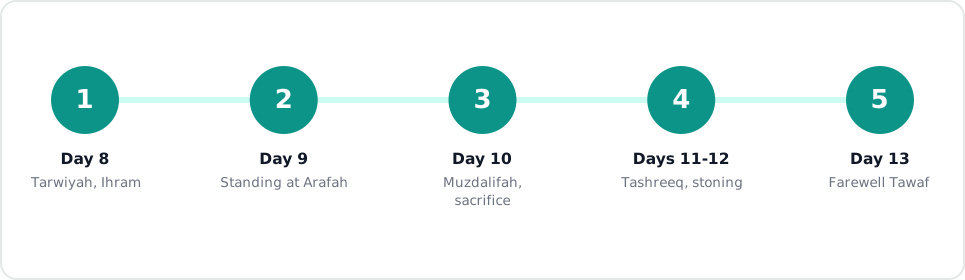
The core of Hajj unfolds over six days on the Hijri calendar, from the 8th to the 13th of Dhul Hijjah:
- 8th of Dhul Hijjah — Yawm al-Tarwiyah: Pilgrims already in Makkah enter (or re-enter) the state of ihram and head to Mina, spending the day and night there in preparation, a day traditionally used for reflection and prayer.
- 9th of Dhul Hijjah — Yawm Arafah: The heart of Hajj. Pilgrims travel from Mina to the plain of Arafah and perform the standing (wuquf) — present on the plain from noon until sunset, engaged in supplication, remembrance, and reflection. Missing this standing invalidates that year's Hajj entirely; every other rite has some accommodation for hardship, but wuquf at Arafah does not.
- 9th–10th (night) — Muzdalifah: After sunset, pilgrims travel to Muzdalifah, where they pray Maghrib and Isha combined and spend the night, typically under open sky, gathering the small pebbles used the next day for stoning the Jamarat.
- 10th of Dhul Hijjah — Eid al-Adha: A day with several rites in sequence — stoning the largest of the three Jamarat (Jamarat al-Aqabah) with seven pebbles, performing the animal sacrifice (hady) for those doing Tamattu' or Qiran, then shaving or trimming the hair, which lifts most ihram restrictions (the "first release"). Many pilgrims also perform Tawaf al-Ifadah, a core pillar of Hajj, either this day or over the following days.
- 11th–13th of Dhul Hijjah — Days of Tashreeq: Pilgrims remain in Mina, stoning all three Jamarat (the small, medium, and large) each afternoon in a specific sequence, seven pebbles at each. Most pilgrims depart after the 12th (an accepted early departure known as ta'jil), while others stay through the 13th (ta'khir); both are valid options described in the Quran itself. Before finally leaving Makkah, pilgrims perform a farewell Tawaf (Tawaf al-Wada').
Throughout these days, keeping an accurate count of Tawaf circuits and stoning pebbles matters more than people expect in the middle of large crowds — Ihsabha's Tawaf Counter and Sa'i Counter are built for exactly this, and our guide to correctly counting Tawaf and Sa'i explains the common counting mistakes to avoid. You can find a fuller explanation of this specific point in Zakat on Retirement Accounts and Pension Funds.
Counting the Days Accurately
Because the days of Hajj follow the Hijri calendar and most pilgrims plan around Gregorian travel dates, converting between the two — and tracking exactly how many days remain before departure — is one of the most common practical questions during preparation. Sighting-based differences between countries can also shift the exact Gregorian date of the 9th of Dhul Hijjah by a day, which is worth confirming close to travel rather than assuming it matches a generic online calendar.
Plan your timeline with Ihsabha's Hajj Days & Duration Calculator, or walk through every stage in order with our Hajj Step-by-Step Guide. For the underlying date conversion, our Hijri-Gregorian Converter and conversion guide cover exactly how the two calendars line up.
When a Rite Can't Be Completed: Fidyah
Sometimes illness, disability, or genuinely unavoidable circumstances make it impossible to complete a specific obligatory rite — needing a haircut for a medical reason while still in ihram, for example, or being physically unable to complete a required walk. In these cases, fidyah (compensation) is due instead of the missed rite itself. Depending on which rite was affected, fidyah generally takes one of three forms: feeding a set number of poor people, fasting a set number of days, or offering a sacrifice — the specific form and quantity depends on the rite in question, and differs from the separate concept of dam (blood, i.e. sacrifice) owed automatically for choosing Tamattu' or Qiran, or for certain other violations of ihram restrictions.
Not sure which fidyah applies to your situation? Ihsabha's Fidyah Calculator walks you through the common cases and gives you a clear, calculated answer, and our full fidyah guide covers who must pay it and how much. For a deeper look, our guide on Zakat on Cash and Bank Savings: How Much You Owe covers this in more detail. For an instant, practical check, the Hajj Days & Duration Calculator is ready to go.
Practical Packing and Health Tips
Beyond the spiritual preparation, a few practical details make the physical journey noticeably easier. Comfortable, well broken-in sandals matter more than almost anything else, since ihram requires footwear that leaves the top of the foot exposed, and blisters develop fast across the distances between Mina, Arafah, and the Jamarat. A small crossbody bag for identification, phone, and a printed copy of your accommodation details is worth carrying at all times, since crowds can separate travel groups quickly, particularly around the Jamarat on the Days of Tashreeq. Sun protection — an umbrella, electrolyte sachets, and a refillable water bottle — is not optional given how much time is spent outdoors at Arafah and Muzdalifah under open sky. Many pilgrims also bring a lightweight prayer mat and a small booklet of the supplications specific to each rite, since trying to recall or look them up in the moment, in a dense crowd, is harder than it sounds.
For those with chronic health conditions, it's worth discussing the physical demands of Hajj with a doctor before travel and carrying a clearly labeled supply of any regular medication, along with a brief medical summary in case of an emergency — heat exhaustion and dehydration are the most common medical issues pilgrims encounter, and both are largely preventable with consistent hydration and rest.
Life After Hajj
Completing Hajj is often described as returning "as the day your mother bore you" — a fresh spiritual starting point rather than an end point. Many pilgrims use the months after Hajj to sustain habits they built during the journey: the discipline of five daily prayers on time, generosity through zakat and sadaqah, and the reflective mindset built during the standing at Arafah. It's also a natural point to review your zakat records for the year, since travel, sacrifice costs, and any fidyah paid can affect your overall annual giving picture — Ihsabha's guide to tracking your zakat payments is a useful next read if you haven't kept a running record before.
Common Mistakes First-Time Pilgrims Make
- Not deciding the Hajj type in advance. Your intention at the miqat needs to be settled before you arrive there, not figured out on the spot.
- Underestimating physical demands. The distances between Mina, Arafah, and Muzdalifah, combined with heat and crowd density, catch many first-timers off guard — building stamina beforehand genuinely helps.
- Losing track of pebble and Tawaf counts in dense crowds, which leads to uncertainty about whether a rite was completed correctly — a dedicated counter removes the guesswork.
- Assuming ihram restrictions lift all at once. The "first release" after shaving/trimming on the 10th lifts most restrictions, but not all — full release only follows the farewell Tawaf and completion of all remaining rites.
- Leaving zakat or other financial obligations unresolved before travel, assuming Hajj expenses "cover" them — they're separate obligations entirely.
Frequently Asked Questions
What are the three types of Hajj?
The three types are Ifrad, Tamattu', and Qiran, and the choice depends on whether and how a pilgrim combines Hajj with Umrah. Tamattu' is the most common for pilgrims traveling from outside Saudi Arabia and requires a sacrifice; Ifrad performs Hajj alone with no sacrifice obligation; Qiran combines both in one continuous ihram and also requires a sacrifice.
What happens during the main days of Hajj?
From the 8th to 13th of Dhul Hijjah, pilgrims enter ihram and go to Mina, stand at Arafah on the 9th, travel to Muzdalifah to collect pebbles, stone the Jamarat and sacrifice on the 10th, then stay in Mina for the Days of Tashreeq before a farewell Tawaf.
What is fidyah and when is it due during Hajj?
Fidyah is compensation owed when illness, disability, or unavoidable circumstances make it impossible to complete a specific obligatory rite. Depending on the rite affected, it generally takes the form of feeding a set number of poor people, fasting a set number of days, or offering a sacrifice.
Who is required to perform Hajj?
Hajj is obligatory once in a lifetime on every adult Muslim who is sane, physically able to make the journey, and financially able to cover its cost and their dependents' needs while away — a condition scholars call istita'ah.
What is the difference between Hajj and Umrah?
Hajj is obligatory once in a lifetime for those who are able, can only be performed during specific days of Dhul Hijjah, and includes rites such as standing at Arafah that Umrah does not. Umrah is a shorter, recommended pilgrimage that can be performed at any time of year and consists mainly of Tawaf and Sa'i.
Do women need a mahram to perform Hajj?
According to the majority of scholars, a woman traveling for Hajj should be accompanied by a mahram (a husband or close male relative she cannot marry), though some contemporary fatwa councils permit women to travel in a trusted, organized group of other women when a mahram is not available, particularly for older women or when safety can be reasonably assured.
A Note on Accuracy
This guide covers the general structure most pilgrims follow. Specific situations — illness, missed rites, questions about your particular Hajj type, or country-specific sighting differences for the Hijri date — should be confirmed with a qualified scholar or your Hajj group's religious guide before or during the pilgrimage.
Keep Exploring
Put this into practice with Ihsabha's Qibla Direction Finder and Ramadan Daily Planner for the rest of your worship planning. For related reading on Ihsabha's blog, see Umrah Guide for First-Timers, Tawaf and Sa'i Counter: How to Correctly Count Your Circuits, and Fidyah: Who Must Pay It and How Much.