Umrah Guide for First-Timers
Which Miqat applies to your route, and the correct order of rituals from Ihram to Tahallul.
Published September 1, 2026 · Reviewed by the Ihsabha Editorial Team
Umrah is a shorter, non-obligatory pilgrimage that can be performed at any time of year, built around a fixed sequence of rites. For pilgrims traveling from different countries and directions, knowing exactly which Miqat applies to their route, how to enter Ihram correctly, and what comes next once they arrive in Makkah, is one of the most common sources of pre-trip uncertainty — this guide walks through the whole journey together, from before you enter Ihram to completing Tahallul, including practical details many first-timers only discover once they're already there.
What Is Umrah?
Umrah consists mainly of Tawaf (circling the Kaaba) and Sa'i (walking between the hills of Safa and Marwah), bookended by entering Ihram beforehand and Tahallul afterward. Unlike Hajj, it isn't tied to specific days of the Islamic calendar and isn't obligatory in the way Hajj is — it's a strongly recommended act of worship that can be performed any time of year, whether on its own or combined with Hajj during the Hajj season. For a deeper look, our guide on Zakat on Cryptocurrency and Bitcoin: How Much You Owe covers this in more detail. For an instant, practical check, the Umrah Route Planner is ready to go.
What Is a Miqat?
Islamic law fixes five boundary points, called Miqat, surrounding Makkah. A pilgrim traveling toward the city from a given direction is expected to enter the sacred state of Ihram no later than the Miqat point on their path — not earlier out of excessive caution, and not later, which would require an act of expiation (typically a sacrifice) to correct. Skipping past your Miqat without entering Ihram, even unintentionally, is one of the more common first-timer mistakes, so it's worth knowing your specific point in advance rather than figuring it out en route.
The Five Classical Miqat Points
Dhul Hulaifah serves those coming from Madinah; Al-Juhfa, near modern Rabigh, serves those arriving from Syria, Egypt, and North Africa; Qarn al-Manazil serves those coming from Najd and the Gulf; Yalamlam serves those arriving from Yemen and much of South and Southeast Asia; and Dhat Irq serves those coming from Iraq. Airlines flying into Jeddah typically announce the relevant Miqat as the aircraft nears it, letting passengers enter Ihram in flight if they haven't already, and many pilgrims choose to enter Ihram at their home airport before departure entirely, which is also valid and removes any risk of missing the announcement.
Entering Ihram: What to Wear and What to Intend
Ihram is both a physical state and a spiritual one. For men, it consists of two seamless white sheets — one wrapped around the waist, one draped over the shoulder — along with sandals that leave the top of the foot exposed. For women, it's simply ordinary, modest clothing in any color, without a face veil or gloves, though many choose white or simple colors by custom rather than religious requirement. Before crossing the Miqat, it's recommended to perform ghusl (a full ritual wash), apply unscented care to the body if needed, and then state the intention (niyyah) for Umrah specifically, followed by reciting the Talbiyah — a set formula declaring one's presence for the pilgrimage — repeated throughout the journey to Makkah.
Once in Ihram, several actions become prohibited until Tahallul: cutting hair or nails, using scented products, hunting, marital relations, and for men specifically, covering the head or wearing stitched garments. Minor, unintentional violations are generally addressed through a specific act of expiation depending on what occurred, rather than invalidating the Umrah entirely. You may also find it useful to check Zakat on Salary and Employment Income: How Much You Owe, which covers a related angle.
The Step-by-Step Order of Umrah
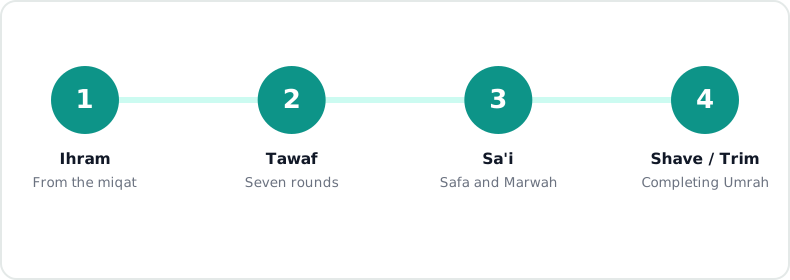
Once in Ihram, the sequence is: Try the Umrah Route Planner to run these numbers with your own figures.
- 1. Travel to Makkah reciting the Talbiyah throughout the journey.
- 2. Perform Tawaf — seven circuits around the Kaaba, starting and ending at the Black Stone corner (Hajar al-Aswad), moving counter-clockwise, with the Kaaba kept on your left. Men are recommended to walk at a brisk pace (raml) for the first three circuits, where crowd conditions allow, then a normal pace for the remaining four.
- 3. Pray two units (rak'ahs) near Maqam Ibrahim if possible, or anywhere within the mosque if the immediate area is too crowded.
- 4. Drink Zamzam water, available throughout the mosque.
- 5. Perform Sa'i — seven legs walking between the hills of Safa and Marwah, starting at Safa; each one-way trip counts as one leg, so the full seven legs end at Marwah, not back at Safa.
- 6. Finish with Tahallul — cutting or shaving the hair — which lifts the restrictions of Ihram and completes Umrah.
Tawaf in More Detail
Each of the seven circuits should begin and end level with the Black Stone corner, and pilgrims traditionally either touch or kiss it if safely possible, or simply gesture toward it with the right hand while saying "Allahu Akbar" when crowd conditions make physically reaching it impractical or unsafe — a gesture is entirely sufficient and doesn't diminish the validity of the Tawaf. Keeping an accurate count of completed circuits matters more than most first-timers expect, especially in dense crowds where it's easy to lose track after the third or fourth lap; many pilgrims use a simple tally method, a prayer bead counter, or a dedicated counting tool rather than relying on memory alone.
Sa'i in More Detail
Sa'i commemorates Hajar's search for water for her son Isma'il, walking between the hills of Safa and Marwah seven times. Men are recommended to jog briefly between two green markers along the path (where the original valley floor made the walk more strenuous), while women walk the entire distance at a normal pace throughout. As with Tawaf, keeping count is genuinely important here too — seven legs total, ending at Marwah — and the same counting tools that help with Tawaf apply equally well to Sa'i. It's also worth reading Zakat on Retirement Accounts and Pension Funds if this situation applies to you.
What Is Tahallul?
Tahallul is the final ritual act: cutting a small portion of the hair, or shaving fully (which is preferred and carries greater reward for men specifically), immediately after completing Sa'i. Women only trim a small portion, roughly a fingertip's length, rather than shaving. Performing it ends the sacred state of Ihram and marks Umrah as complete — restrictions like scented products, cutting nails, and marital relations are all lifted immediately once Tahallul is done.
Follow every step without losing your place. Ihsabha's Umrah Route Planner lets you pick your Miqat and check off each ritual in order, saving your progress automatically between sessions, and our Tawaf Counter and Sa'i Counter keep an accurate tally through the crowds so you never have to guess.
Performing Umrah More Than Once on the Same Trip
Many pilgrims choose to perform a second or third Umrah during the same trip, often on behalf of a family member who couldn't travel, or simply to repeat the experience. Since you're already inside the sacred boundary (Haram) after your first Umrah, you can't simply restart from where you are — you need to travel to a Miqat point outside the boundary to re-enter Ihram properly. Masjid Aisha in Tan'im is the most commonly used point for this specifically because of its proximity to Makkah, making a same-day repeat Umrah practical for many pilgrims. To save time, enter your values into the Umrah Route Planner and get an instant result.
Health and Comfort in Makkah's Climate
Makkah's climate is hot and often crowded year-round, and this affects Umrah planning more than first-timers usually expect. Performing Tawaf and Sa'i can take anywhere from 30 minutes to over an hour depending on crowd density, almost entirely on your feet, often in direct heat if performed outside cooler indoor sections of the mosque. Staying well hydrated before and during the rituals, choosing cooler times of day where your schedule allows (early morning or late evening tend to be less crowded and cooler than midday), and pacing yourself rather than rushing through both rituals back-to-back without rest are all practical adjustments that make a real difference, particularly for elderly pilgrims, young children, or anyone with a health condition affected by heat and exertion. This naturally leads to a related question, answered in Zakat on Cash and Bank Savings: How Much You Owe.
Performing Umrah With Family or Elderly Relatives
Traveling as a family group adds its own layer of planning. Wheelchair services are widely available for Tawaf and Sa'i for those unable to walk the full distance, and many pilgrims accompanying elderly or unwell relatives arrange this in advance rather than discovering the option only once on-site. Young children who haven't reached puberty aren't obligated to perform Umrah, though many families still bring them through the rituals in a simplified or supervised way; a companion should stay close to any child throughout, since the crowds around Tawaf in particular can separate a family quickly. Assigning one adult specifically to keep track of children, rather than assuming everyone is equally watching, avoids one of the more stressful and common problems large family groups encounter.
Recommended Supplications and Etiquette
While there is no single obligatory wording required during Tawaf or Sa'i beyond general remembrance of God, many pilgrims recite specific supplications passed down through tradition at various points — between the Yemeni Corner and the Black Stone during Tawaf, for example, a well-known supplication asks for good in this life and the next. Carrying a small booklet or phone app with these supplications is common and practical, since trying to recall them from memory in the moment, amid a large moving crowd, is harder than it sounds. Beyond specific wording, general etiquette matters too: keeping voices low, being mindful of the personal space and safety of pilgrims around you (especially the elderly or those in wheelchairs), and avoiding pushing or cutting through the flow of the crowd during Tawaf all contribute to a more reflective, less physically stressful experience for everyone present, not just yourself.
Practical Tips for First-Timers
- Learn your Miqat before you travel rather than relying on in-flight announcements alone, especially if you're taking an indirect route.
- Wear comfortable, broken-in sandals since Ihram requires footwear that exposes the top of the foot, and you'll be walking and standing for extended periods.
- Keep a small bag for identification and essentials that you can carry throughout Tawaf and Sa'i, since crowds can make it hard to return to a fixed spot.
- Stay hydrated, especially during Sa'i, and take advantage of the freely available Zamzam water throughout the mosque.
- Don't rush the counting — pause briefly if you lose track rather than guessing, since an inaccurate count can mean redoing part of the ritual later.
Common Mistakes First-Timers Make
- Passing the Miqat without entering Ihram, often because the pilgrim wasn't sure exactly where their specific boundary point was along their route.
- Losing count during Tawaf or Sa'i in dense crowds and either under- or over-completing the required circuits or legs.
- Assuming Tahallul happens automatically after Sa'i, rather than being a deliberate final act — Umrah isn't complete, and Ihram restrictions remain in force, until the hair is actually cut or shaved.
- Not knowing how to perform a repeat Umrah correctly, and mistakenly trying to begin a second Umrah's rituals without first traveling back out to a Miqat point to re-enter Ihram.
- Underestimating the physical demands of heat and crowds, particularly for elderly travelers or young children, without planning for hydration, rest, or wheelchair assistance where needed.
- Losing track of children or elderly family members in dense crowds during Tawaf, without assigning clear responsibility for keeping the group together.
Frequently Asked Questions
What is a Miqat and why does it matter?
A Miqat is one of five fixed boundary points around Makkah where a pilgrim arriving from that direction must enter the state of Ihram before continuing. Entering Ihram before or after your Miqat can require an act of expiation to correct.
What is the correct order of Umrah rituals?
Enter Ihram at your Miqat, travel to Makkah reciting the Talbiyah, perform Tawaf (seven circuits around the Kaaba), pray two units near Maqam Ibrahim if possible, drink Zamzam water, perform Sa'i (seven legs between Safa and Marwah), then finish with Tahallul, cutting or shaving the hair.
Which Miqat applies if I arrive by airplane?
Most airlines flying into Jeddah announce the relevant Miqat boundary as the plane crosses it, since Jeddah lies within range of several classical Miqat points depending on the flight path. Many pilgrims enter Ihram at the airport itself before landing.
What are men and women allowed to wear in Ihram?
Men wear two seamless white sheets, one wrapped around the waist and one over the shoulder, with sandals that leave the top of the foot exposed. Women wear ordinary, modest clothing in any color, without a face veil or gloves, though many choose white or simple colors by custom rather than requirement.
Can Umrah be performed more than once in a trip?
Yes. Many pilgrims perform a second or third Umrah during the same trip, typically by traveling to a nearby Miqat point outside the sacred boundary, such as Masjid Aisha in Tan'im, to re-enter Ihram and repeat the rituals, often on behalf of a family member who could not travel.
What should I do if I make a mistake during the Umrah rituals?
Minor, unintentional errors such as losing count of Tawaf circuits or Sa'i legs are generally corrected by simply completing the missing portion once realized, since intention and reasonable effort matter more than an isolated counting slip. For more significant issues, such as violating an Ihram restriction, consulting a scholar on-site or before continuing is recommended.
Are children required to perform Umrah?
No, children who haven't reached puberty aren't religiously obligated to perform Umrah, though many families still bring them through a simplified or supervised version of the rituals as a formative experience, with a designated adult staying close throughout to prevent separation in crowds.
A Note on Accuracy
These Miqat points and the overall sequence are agreed upon in outline by all four major schools of Islamic jurisprudence, with only minor variation in supporting details. For questions specific to your itinerary or personal circumstances, it's best to confirm with a qualified local scholar before you travel.
Keep Exploring
Put this into practice with Ihsabha's Hajj Step-by-Step Guide and Hijri-Gregorian Converter. For related reading on Ihsabha's blog, see The Complete Hajj Guide, Tawaf and Sa'i Counter: How to Correctly Count Your Circuits, and Prayer While Traveling: Qasr and Jam Explained.