Islamic Inheritance Calculator: How Mirath Shares Are Determined
Understanding fixed heirs, residuary heirs, and how the shares are calculated.
Published August 24, 2026 · Reviewed by the Ihsabha Editorial Team
Islamic inheritance law — known as mirath or fara'id — is one of the most precisely detailed areas of Islamic jurisprudence, with share ratios set out directly in the Quran rather than left to later interpretation. Because the exact share each heir receives depends entirely on which relatives survive the deceased, and how their presence affects each other's entitlements, the system can feel complex at first glance. This guide walks through what happens before distribution even begins, the two main categories of heirs, the principle of exclusion between relatives, two advanced adjustments called awl and radd, and worked examples to make the whole system concrete.
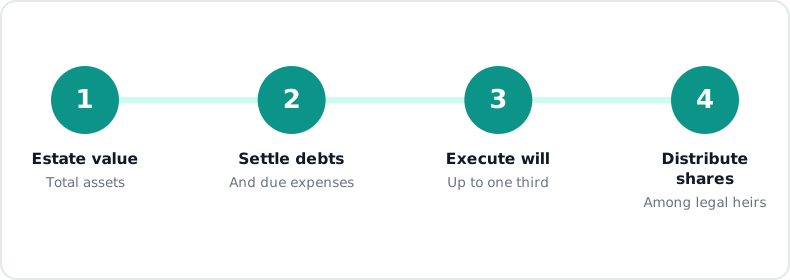
Before Distribution: Four Steps, In Order
A common misconception is that the entire estate is immediately divided among heirs the moment someone passes away. In fact, Islamic law requires several steps to happen first, in a specific sequence:
- 1. Funeral and burial expenses are paid from the estate first, covering reasonable costs for the burial itself.
- 2. Outstanding debts the deceased owed are settled next — to other people, institutions, or as unpaid zakat — before anything is distributed to heirs.
- 3. A bequest (wasiyyah), if the deceased left one, is honored next, but capped at a maximum of one-third of the remaining estate. In the majority view, a wasiyyah generally cannot be made to someone who is already a fixed Quranic heir, since that would effectively increase their share beyond what fara'id assigns them — it's meant for others, such as a friend, a charity, or a relative who wouldn't otherwise inherit.
- 4. What remains after these three steps — often referred to as the net estate — is what's actually distributed among the heirs according to the fara'id shares described below.
Skipping straight to heir shares without first accounting for debts and a possible bequest is one of the most common calculation errors, since it overstates what's actually available for distribution. You may also find it useful to check Zakat on Cryptocurrency and Bitcoin: How Much You Owe, which covers a related angle. To save time, enter your values into the Islamic Inheritance Calculator and get an instant result.
Two Main Categories of Heirs
1. Fixed-Share Heirs (Dhawu al-Furud)
These heirs receive a specific fraction of the net estate defined directly by the Quran — 1/2, 1/4, 1/8, 1/3, 2/3, or 1/6 — depending on their relationship to the deceased and which other relatives are also alive at the time of death. Common examples:
- Spouse: A husband receives 1/4 of his wife's estate if she left children, or 1/2 if she didn't. A wife receives 1/8 if her husband left children, or 1/4 if he didn't — and if there are multiple wives, this share is divided equally among them.
- Mother: Typically 1/6 if the deceased left children or two or more siblings, otherwise 1/3 of the estate (or, in a specific scenario involving both a father and a spouse together, 1/3 of the remainder after the spouse's share — a nuance called "gharrawayn" that trips up many manual calculations).
- Father: Receives a fixed 1/6 if the deceased left children, plus a residuary share on top if there are no sons (since a father can inherit in both the fixed and residuary categories depending on the family structure).
- Daughter(s): A single daughter with no sons present receives 1/2; two or more daughters with no sons share 2/3 between them — but the moment even one son is present, all daughters shift out of this fixed category entirely and into the residuary category below.
2. Residuary Heirs (Asabah)
After fixed shares are distributed, whatever remains of the net estate goes to residuary heirs — typically sons, and daughters when they inherit alongside sons, plus in some family structures the father, brothers, or other specific male relatives depending on who is present. The standard ratio when sons and daughters inherit together as residuaries is 2 shares for a son to every 1 share for a daughter. If there is no residue left after fixed shares are fully allocated (which happens in some family structures), residuary heirs simply receive nothing that year — their claim only applies to whatever remains, never to a guaranteed minimum.
A Third, Rarer Category: Dhawu al-Arham
In cases where neither fixed heirs nor residuary heirs exist at all — an increasingly rare scenario, since spouses and children cover most estates — a third category called dhawu al-arham (distant kindred, such as maternal uncles or grandchildren through a daughter) may inherit under specific conditions recognized by some schools of thought. This category is genuinely uncommon in practice and, when it becomes relevant, is exactly the kind of situation that calls for direct scholarly guidance rather than general calculation.
Hajb: How One Relative Can Exclude Another
One of the most important — and most frequently misunderstood — principles in fara'id is hajb, exclusion. The presence of a closer relative can fully or partially block a more distant relative from inheriting at all, or reduce their share. A few illustrative examples: a surviving son fully excludes the deceased's siblings from any share whatsoever; the presence of children shifts a spouse's and a mother's shares to lower fractions than they'd otherwise receive; a father excludes the deceased's own siblings and grandfather from inheriting. This interdependence is exactly why the presence or absence of a single relative can change everyone else's shares, and why manual calculation becomes genuinely error-prone once a family structure goes beyond the simplest cases. It's also worth reading Zakat on Salary and Employment Income: How Much You Owe if this situation applies to you. Use the Islamic Inheritance Calculator below to check your own numbers quickly and accurately.
Awl and Radd: When the Fractions Don't Add Up Cleanly
Two more advanced adjustments come into play in specific situations:
- Awl (proportional reduction): occasionally, the fixed shares assigned to multiple heirs add up to more than the whole estate (for example, a combination that sums to 13/12 instead of 12/12). When this happens, every heir's share is proportionally reduced so the total still equals the full estate, preserving the ratio between heirs while fitting within 100% of the available wealth.
- Radd (return): the opposite situation — fixed shares add up to less than the whole estate, and there are no residuary heirs present to absorb the remainder. In this case, the leftover is returned proportionally to the fixed heirs (excluding a spouse, in the majority view, who typically doesn't receive a share of the radd), increasing their shares above their base fraction.
Both awl and radd are mathematically precise but easy to get wrong by hand, which is exactly the kind of calculation a dedicated tool handles more reliably than manual arithmetic.
Siblings and Grandparents: When They Inherit
Siblings and grandparents only enter the picture in specific circumstances, since closer relatives generally exclude them under hajb, and this is one part of fara'id where families are most often surprised by the outcome — many people assume a deceased sibling's own brothers and sisters will inherit automatically, only to discover that a surviving spouse and children exclude them entirely. A grandfather can inherit as a substitute for a deceased father in some structures, typically receiving the father's fixed 1/6 share (with scholarly differences on exactly how this interacts with other heirs). Full siblings, paternal siblings, and maternal siblings each have distinct rules: maternal siblings (sharing only the mother) receive fixed shares — 1/6 for one, 1/3 shared among two or more — and are excluded entirely by the presence of children or a father, regardless of gender. Full and paternal siblings, by contrast, typically inherit as residuary heirs and are excluded specifically by the presence of a son, a father, or (in most views) a grandfather, but not automatically by daughters alone. This is one of the more genuinely intricate corners of fara'id, and it's exactly where the difference between "no direct descendants" and "no descendants and no father" changes the entire distribution. You can find a fuller explanation of this specific point in Zakat on Retirement Accounts and Pension Funds.
Blended Families and Multiple Marriages
Blended families raise questions that don't come up in simpler cases. Children from a deceased person's earlier marriage inherit exactly the same fixed or residuary shares as children from a current marriage — Islamic inheritance law doesn't distinguish between children by different mothers or fathers in terms of entitlement, only by their relationship to the specific deceased person whose estate is being distributed. A stepparent, by contrast, has no inheritance right at all unless a valid bequest (within the one-third cap, and only if they aren't already a blood or marital heir through some other relationship) was specifically made for them, since step-relationships don't create a fara'id entitlement on their own. You can use the Islamic Inheritance Calculator to get the result instantly, with no manual math.
How Wills and Civil Law Interact With Fara'id
In many countries where Muslims live as a minority, civil inheritance law — not fara'id — governs by default unless a valid will specifies otherwise, which means a Muslim's estate could be distributed in a way that doesn't match Islamic shares at all if no will exists. This has made drafting a will that explicitly directs the estate to be distributed according to fara'id (within whatever a country's civil law permits, since some jurisdictions restrict how much a will can override default succession rules) an increasingly important practical step, not just a religious preference. In countries with an Islamic family law system, courts may apply fara'id directly, but even there, family members sometimes still draft an explicit will to avoid ambiguity or family disputes over exactly how the shares were calculated. Either way, the one-third bequest cap and the restriction against bequeathing to existing fixed heirs generally still apply to the will's Islamic validity, regardless of what the local civil law technically permits. This naturally leads to a related question, answered in Zakat on Stocks and Investments: How to Calculate What You Owe.
A Simplified Worked Example
A man passes away leaving a wife, one son, and one daughter, with no surviving parents, and a net estate (after debts and any bequest) of $240,000. The wife receives 1/8, since there are children: $240,000 × 1/8 = $30,000. The remaining $210,000 is split between the son and daughter as residuary heirs at a 2:1 ratio — three total shares, the son taking two of them and the daughter one: the son receives $140,000, and the daughter receives $70,000.
A second example with a mother present. A woman passes away leaving her husband, her mother, and two daughters (no sons), with a net estate of $180,000. The husband receives 1/4 (children are present): $45,000. The mother receives 1/6 (children are present): $30,000. The two daughters, with no sons present, share 2/3 between them as fixed heirs: $120,000, or $60,000 each. Total distributed: $45,000 + $30,000 + $60,000 + $60,000 = $195,000 — which exceeds the $180,000 estate, triggering awl: every share is proportionally reduced by the same ratio (180,000/195,000) so the total exactly matches the available estate.
Get the exact breakdown for your family. Ihsabha's Islamic Inheritance Calculator takes your specific list of surviving heirs and instantly returns each person's correct share — including awl and radd adjustments automatically — no manual fiqh calculation required.
Common Mistakes
- Distributing the gross estate without first deducting funeral costs, debts, and any valid bequest.
- Allowing a bequest to a fixed heir, or exceeding the one-third cap on a bequest to a non-heir.
- Forgetting hajb (exclusion) and assigning a share to a relative who is actually excluded by the presence of a closer one, such as giving siblings a share when a son survives.
- Missing the shift from fixed to residuary for daughters the moment a son is present, which changes both the fraction and the calculation method entirely.
- Not checking whether the shares sum to exactly the whole estate, which is precisely when awl or radd adjustments are needed and easy to miss by hand.
- Assuming step-relationships create automatic inheritance rights, when in fact only a specific, capped bequest can provide for a stepchild or stepparent who isn't otherwise a blood or marital heir.
- Relying on default civil law without a will in countries where Islamic shares aren't applied automatically, resulting in a distribution that doesn't reflect fara'id at all.
Frequently Asked Questions
What share does a wife get?
1/8 of the net estate if there are children, or 1/4 if there are none — divided equally among multiple wives.
Do daughters inherit?
Yes — a single daughter with no sons receives 1/2; two or more daughters with no sons share 2/3; alongside sons, daughters inherit as residuary heirs at a 1:2 ratio to sons.
What's the difference between fixed and residuary heirs?
Fixed heirs receive an exact Quranic fraction regardless of the estate size; residuary heirs split whatever remains afterward, and may receive nothing if fixed shares consume the entire estate.
What has to happen before the estate is distributed to heirs?
Funeral expenses are paid first, then any debts the deceased owed are settled, then up to one-third of the remaining estate can be allocated to a bequest (wasiyyah) for a non-heir if one was made. Only what remains after these steps is distributed among the heirs according to fara'id.
What is hajb (exclusion) in Islamic inheritance?
Hajb is the principle by which the presence of a closer relative fully or partially blocks a more distant relative from inheriting. For example, a surviving son excludes the deceased's siblings entirely from any share of the estate.
Can a Muslim leave their entire estate to whoever they choose in a will?
No. In the majority view, a bequest (wasiyyah) is capped at one-third of the net estate and generally cannot be made to someone who is already a fixed Quranic heir, since that would effectively increase their share beyond what fara'id assigns. The remaining portion is distributed according to the fixed inheritance shares regardless of personal wishes.
Do grandparents inherit if the parents have already passed away?
A grandfather can inherit in place of a deceased father in many family structures, typically receiving a share similar to the father's fixed 1/6, with some scholarly variation in how this interacts with other surviving relatives. A grandmother can similarly inherit in place of a deceased mother in certain circumstances, generally at a 1/6 fixed share when applicable.
A Note on Accuracy
Inheritance calculations can involve additional complexities beyond what's covered here — unusual family structures involving grandparents and siblings together, disputes over paternity or marital status, estates spanning multiple countries with different legal systems, or situations requiring dhawu al-arham. For estate matters of any significant value, consulting a qualified scholar or Islamic inheritance specialist alongside the calculator is strongly recommended, and in many countries it's also worth understanding how local civil inheritance law interacts with — or in some jurisdictions, needs to be reconciled with — the Islamic shares through a valid will.
Keep Exploring
Put this into practice with Ihsabha's Zakat Calculator for the estate's zakat obligations, and our Hijri-Gregorian Converter for dating estate documents. For related reading on Ihsabha's blog, see How to Track Your Zakat Payments Every Year, Who Is Eligible to Receive Zakat?, and Zakat on Cash and Bank Savings.