How to Calculate Zakat on Gold and Silver
A step-by-step guide to nisab, the hawl year, and the 2.5% rate.
Published August 22, 2026 · Reviewed by the Ihsabha Editorial Team
Zakat on gold and silver is one of the most commonly asked-about categories of zakat, and for good reason: most people hold at least some savings in cash, jewelry, or both, and gold in particular carries cultural and family significance in many Muslim households that makes the calculation feel more personal than a simple bank balance. The core calculation is straightforward once you understand three ideas — nisab, the hawl (lunar year), and the 2.5% rate — but purity, jewelry, and mixed holdings each add a layer of nuance this guide walks through in full.
What Is Nisab?
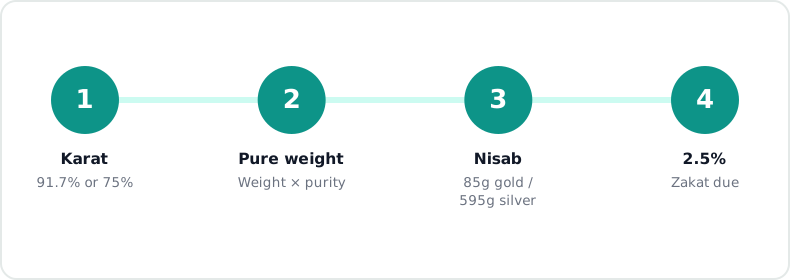
Nisab is the minimum amount of wealth a Muslim must own before zakat becomes obligatory. For gold, the standard nisab is 85 grams of pure gold (or its equivalent cash value). For silver, it is 595 grams of pure silver. If your combined gold, silver, and cash savings are below the applicable threshold, no zakat is due that year.
Because gold and silver prices change daily and gold's price per gram is typically many times higher than silver's, the two nisab figures translate into very different cash thresholds — the silver nisab is almost always the lower one. Because of this, many scholars recommend using the silver nisab as the threshold when combining cash savings with gold or silver, since it results in zakat becoming due sooner and is generally considered the more cautious and more generous position toward those in need. For a deeper look, our guide on Zakat on Cryptocurrency and Bitcoin: How Much You Owe covers this in more detail. Use the Gold & Silver Zakat Calculator below to check your own numbers quickly and accurately.
Gold Purity: 24K, 22K, 18K, and What They Mean for Zakat
Most gold jewelry isn't pure 24-karat gold — it's an alloy, typically 22K, 21K, or 18K, mixed with other metals for durability and to achieve different shades. This matters directly for zakat, because the nisab and valuation are based on pure gold content, not the item's total weight as-is.
- 24K gold is 99.9% pure — its full weight counts as pure gold.
- 22K gold is about 91.7% pure (22/24).
- 21K gold is about 87.5% pure (21/24).
- 18K gold is 75% pure (18/24).
To find the pure gold content of a piece, multiply its total weight by its purity percentage. A 20-gram 22K gold necklace contains roughly 20 × 0.917 ≈ 18.3 grams of pure gold. In practice, many people simplify this by using the item's current resale or market value directly — since jewelers typically price pieces according to their actual gold content already — rather than doing the purity math by hand, though understanding the underlying calculation helps you sanity-check that valuation.
The Jewelry Debate: Is Zakat Due on What You Wear?
This is the single most-asked question in this category, and scholars genuinely differ on it:
- Hanafi school: zakat is due on all gold and silver a person owns, regardless of whether it's worn as everyday jewelry or held purely as savings — purpose of use doesn't exempt it.
- Maliki, Shafi'i, and Hanbali schools: jewelry worn regularly for personal adornment, within customary and reasonable limits for one's culture and status, is generally exempt from zakat. Jewelry held as investment, given as a store of value, or exceeding customary personal use is still zakatable under this view.
"Customary limits" is doing real work in that second position, and it's inherently a judgment call shaped by culture, family norms, and personal circumstance — a modest wedding set worn regularly reads very differently from a large collection of gold pieces rarely worn and effectively functioning as savings. If you follow a school that exempts worn jewelry, it's still worth periodically reviewing your holdings honestly: jewelry that hasn't been worn in years and functions more like a safety-deposit-box asset arguably falls back into the zakatable category even under the more lenient view.
Inherited and Gifted Jewelry
Gold jewelry passed down through family or received as a wedding or engagement gift is treated exactly the same as any other gold you own for zakat purposes — inheritance or gifting doesn't change its zakat status. Once it's in your possession and you meet the ownership conditions, it enters your zakat calculation the same way purchased gold would, subject to the same jewelry-exemption debate discussed above depending on which scholarly view you follow. A common point of confusion is assuming that gold "in the family" for generations is somehow exempt from zakat by virtue of its sentimental or historical status — sentimental value has no bearing on the zakat ruling, only ownership, purity, and use do. You can find a fuller explanation of this specific point in Zakat on Salary and Employment Income: How Much You Owe.
Digital Gold, Gold ETFs, and Gold-Backed Accounts
Modern gold ownership increasingly happens outside physical possession — digital gold apps, gold-backed savings accounts, and gold ETFs all let people hold a claim on gold without ever touching a physical bar or coin. For zakat purposes, most contemporary scholars treat these the same as physical gold, provided the underlying asset is genuinely backed by real, allocated gold and you have a genuine ownership claim to it (rather than, say, a derivative or futures contract that merely tracks the gold price without actual ownership). The pure-gold-content calculation still applies, based on the grams of gold your holding represents, valued at the current market price the same way physical gold would be. If you're unsure whether a specific digital gold product represents genuine ownership or just price exposure, it's worth checking the product's terms or asking the provider directly, since this distinction matters for the zakat ruling even if the two feel similar day-to-day. To save time, enter your values into the Gold & Silver Zakat Calculator and get an instant result.
Silver's Often-Overlooked Role
Silver tends to get far less attention than gold in zakat discussions, partly because fewer people hold significant silver wealth today compared to a few generations ago, and partly because gold dominates as the culturally preferred store of value and gift item in most Muslim communities. But silver still plays an outsized role in zakat calculations precisely because of its lower nisab threshold — someone who owns no gold at all but has moderate cash savings may still find that the silver-equivalent nisab is the relevant threshold determining whether they owe zakat this year, even without a single gram of silver actually in their possession. Understanding the silver nisab matters for nearly everyone's zakat calculation, not just those who happen to own silver items.
The Hawl: A Full Lunar Year of Ownership
Zakat is only due on wealth that has stayed at or above the nisab for one full Hijri (lunar) year. If your savings dip below nisab at any point during the year and never recover before the year is up, the hawl resets. Most people find it easiest to pick one fixed date each year — for example, the first day of Ramadan — and calculate zakat on whatever they own on that date, provided it has remained above nisab throughout. If you want to go further, Zakat on Retirement Accounts and Pension Funds explains this point in more depth.
The Zakat Rate: 2.5%
Once nisab and hawl conditions are met, the zakat due is 2.5% of the total value — whether that value is in gold, silver, cash, or a mix of all three. There's no separate, different rate for gold versus silver versus cash once they're all converted to a common currency value; the 2.5% applies uniformly across the combined total.
Combining Gold, Silver, and Cash
Most people don't hold wealth in a single clean category — a typical household might have some gold jewelry, a little silver, and cash savings all at once. The majority view is that these are combined into a single zakat calculation: convert gold and silver to their current cash equivalent, add that to cash savings, compare the total against one nisab standard (typically the silver value, for the reasons explained above), and apply 2.5% to the combined figure if it clears the threshold and has met the hawl. Rather than working this out by hand every time, the Gold & Silver Zakat Calculator can handle the whole calculation for you.
Worked Examples
Example 1 — Simple gold and cash. You own 50 grams of 24K gold and $2,000 in savings, both held for over a year. If gold trades at $70/gram: 50 × $70 = $3,500 in gold, plus $2,000 cash = $5,500 total. Zakat due: $5,500 × 2.5% = $137.50.
Example 2 — Mixed-purity jewelry. You own a 30-gram 22K gold bracelet (≈27.5 grams pure gold at 91.7% purity) and no other zakatable assets. At $70/gram for pure gold: 27.5 × $70 ≈ $1,925. This clears the silver nisab (roughly a few hundred dollars depending on the silver price) but should be checked against the gold nisab too if you follow that standard — either way, at this value zakat is very likely due: $1,925 × 2.5% ≈ $48.13.
Example 3 — Gold, silver, and cash together. You hold 40 grams of pure gold ($2,800 at $70/gram), 200 grams of pure silver ($160 at $0.80/gram), and $1,500 cash. Total: $2,800 + $160 + $1,500 = $4,460. At 2.5%: $111.50 due, assuming the combined total has stayed above the applicable nisab for the full hawl.
Skip the manual math. Ihsabha's Gold & Silver Zakat Calculator handles current gold/silver pricing, purity conversion, nisab comparison, and the 2.5% calculation for you — just enter your holdings and get an instant, accurate result. If cash makes up most of your wealth, the Cash & Savings Zakat Calculator is a faster dedicated option. You may also find it useful to check Who Is Eligible to Receive Zakat? The 8 Categories, which covers a related angle.
Gemstones, Settings, and Mixed-Material Jewelry
Most jewelry isn't pure metal — a ring might combine gold with diamonds, pearls, or other gemstones, and clasps or settings are sometimes made from other metals entirely. For zakat purposes, only the actual gold or silver content is zakatable; gemstones, pearls, and non-precious-metal components are generally excluded from the calculation under the majority view, since they aren't gold or silver at all and don't fall under the same textual basis for the obligation. In practice, this means valuing a diamond ring for zakat requires isolating the gold weight specifically (often stated on a jewelry receipt or appraisal as the "gold weight" separate from stone weight), rather than using the item's full retail price, which typically includes a significant markup for the stones, craftsmanship, and brand that has nothing to do with the zakatable gold content itself.
Finding Accurate Current Prices
Because gold and silver prices shift daily and sometimes significantly within a single day, using an accurate, current price matters for getting the calculation right. Most people use the spot price (the current market rate for a troy ounce or gram of pure metal) from a reliable financial source on their actual calculation date, rather than a price from weeks or months earlier. Local jewelry markets sometimes quote prices that include a markup over the pure spot price, reflecting labor and retail margin — for zakat purposes, the spot price of the pure metal content is the more accurate basis, since zakat is assessed on the underlying wealth, not the retail cost of acquiring it.
Common Mistakes
- Using total item weight instead of pure gold content for 22K, 21K, or 18K pieces, which overstates the zakatable amount.
- Applying the gold nisab when the silver nisab would be lower and more appropriate for combined cash-and-metal calculations, delaying when zakat becomes due unnecessarily.
- Assuming all jewelry is automatically exempt without checking which scholarly view applies, or without honestly assessing whether pieces are genuinely "customary personal use" versus functioning as stored wealth.
- Forgetting to combine gold, silver, and cash into one nisab check, and instead checking each separately against its own full nisab, which can incorrectly conclude no zakat is due when the combined total actually clears the threshold.
- Using outdated gold or silver prices from a previous year rather than the current market rate on the actual calculation date.
- Valuing jewelry at full retail price, including gemstones, craftsmanship, and brand markup, instead of isolating the actual pure gold or silver weight.
- Assuming inherited or gifted gold is exempt due to its sentimental or family significance, when ownership — not origin — determines its zakat status.
Frequently Asked Questions
What is the nisab for zakat on gold and silver?
The nisab is 85 grams of pure gold, or 595 grams of pure silver. If your combined gold, silver, and cash savings stay below this threshold, no zakat is due, and many scholars recommend using the lower silver nisab when combining cash with gold or silver holdings.
How long must gold or silver be held before zakat is due?
Zakat is only due once wealth has remained at or above the nisab for one full Hijri (lunar) year, known as the hawl. If savings dip below nisab and never recover during the year, the hawl resets and the countdown starts again.
What percentage of zakat is due on gold and silver?
Once nisab and hawl are met, zakat due is 2.5% of the total value in gold, silver, or cash. For example, $5,500 in combined gold and cash savings owes $137.50 in zakat.
Is zakat due on gold jewelry a woman wears regularly?
Scholars differ. The Hanafi school holds that zakat is due on all gold and silver regardless of use, including everyday jewelry. The Maliki, Shafi'i, and Hanbali schools generally exempt jewelry worn regularly for personal adornment within customary limits, while still requiring zakat on jewelry held as investment or savings.
How do I calculate zakat on 22K or 18K gold instead of pure gold?
Convert the karat to a purity percentage (22K equals about 91.7% pure, 18K equals 75% pure) and multiply the item's total weight by that percentage to get its pure gold content, then value that amount at the current pure gold price, or use the item's stated market value directly if it already reflects its actual purity.
Do I combine gold, silver, and cash into one nisab check?
Yes, the majority view is that gold, silver, and cash are combined into a single zakat calculation using one nisab standard, typically the silver value, since they all fall under the broader category of monetary wealth rather than being assessed as separate, independent categories.
Is zakat due on digital gold or gold ETFs?
Most contemporary scholars treat digital gold and gold-backed accounts the same as physical gold for zakat purposes, provided the holding represents genuine ownership of real, allocated gold rather than just price exposure through a derivative or futures contract. The same pure-gold-content calculation and nisab comparison apply.
A Note on Accuracy
This article explains the general, widely-followed calculation method. Specific rulings can vary between schools of thought and individual circumstances — the jewelry exemption in particular is genuinely disputed and worth confirming against the view you follow. For anything beyond routine personal savings, it's always best to confirm with a qualified local scholar.
Keep Exploring
Put this into practice with Ihsabha's Trade Assets Zakat Calculator and Stocks Zakat Calculator. For related reading on Ihsabha's blog, see How to Calculate Zakat: The Complete Guide, Zakat on Cash and Bank Savings, and How to Track Your Zakat Payments Every Year.